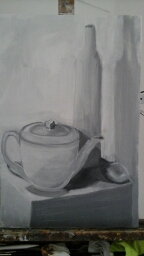
I do not like posting my art work, but then again this trip and blog are all about creativity. Now into our 2nd week of work, I am going to get more technical about what I am learning in the painting classes. Our first composition was a still life of our own choosing from their pile of stuff. Do not, I repeat do not, ever choose a teapot. Way too many ways to render it wrong – I know because that is what I have a whole of practical experience in that department. Another mistake is choosing too many things that are light – or technically called a high end palette. Becomes rather boring, as you can see.
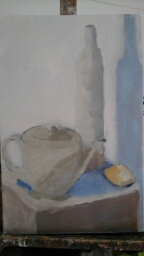
Our next step was to add color by trying to match tones. The technique is to mix the color and then get it to the right shade so it blends in with the tone of the black and white. Again, if you have too light a palette you don’t get interesting contrasts. So, of course, I decided to put more color into the project in order to salvage what I perceived as a very boring and watery painting. Whoops. Better, but the blue pretty much carries the painting away.
Now Jane, our absolutely brilliant and wonderful teacher starts into the good stuff. She gives us some of her refined flaxseed oil and chalk which we mix together into a paste. This is then added to our pigments in varying amounts. This allows us to layer in transluscence by glazing, or add depth through scumbling. In other words, I not only have to think in warms and cools, perspective, opposites, but now in transperancy and opaqueness.

This is now after an afternoon of layering glazes on to the painting. There is a lovely glow which is starting to emerge. I have found that using my fingers is a great way for blending and smoothing shapes. Oh, I forgot. The step I have never heard of before that Jane advocates is to oil out the canvas each time we start to work on it. The canvas must be completely dry for this to work…yup, I found out the hard way it takes off the lower layer if you do this to an almost dry canvas. Oiling out is like taking mayo and spreading it thinly all over the canvas. It is an emulsion of eggwhite and flaxseed which you rub hard until the heat of your hand dries the eggwhite and allows the thin layer of oil to smooth the brushstrokes as you work on the next layer.
Sorry to you non-painters – but this is interesting to me so you get to hear all about it. Next week Jane is going to share how to refine the oil and how to make the emulsion. I’m so excited!
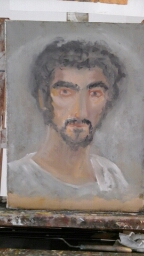
My biggest fear and previous failures have to do with rendering the human body. So of course they put me into figure drawing. Then Jane hands out to all of us prints of Fayum portraits. BTW we had just attended a lecture on these portraits which were done by Greek artists in Egypt around 100 AD – so this wasn’t completely an off – the- wall assignment. So here is my first layer. I will admit an assistant walked me through the process, but all brush strokes are mine. There is a resemblance to a human head. I’m looking forward to making it more so.
Well, I am off to our weekly walk in the Paros countryside.
 Lisa Oberreuter